Koord-Queue
Overview
Koord-Queue is a native Kubernetes job queuing system for the Koordinator ecosystem. It provides job-level queue management with deep integration into Koordinator's ElasticQuota system, enabling resource fairness, reduced scheduler pressure via pre-scheduling, and support for Priority/Block queuing policies. It is purpose-built for multi-tenant AI/ML and batch workloads.
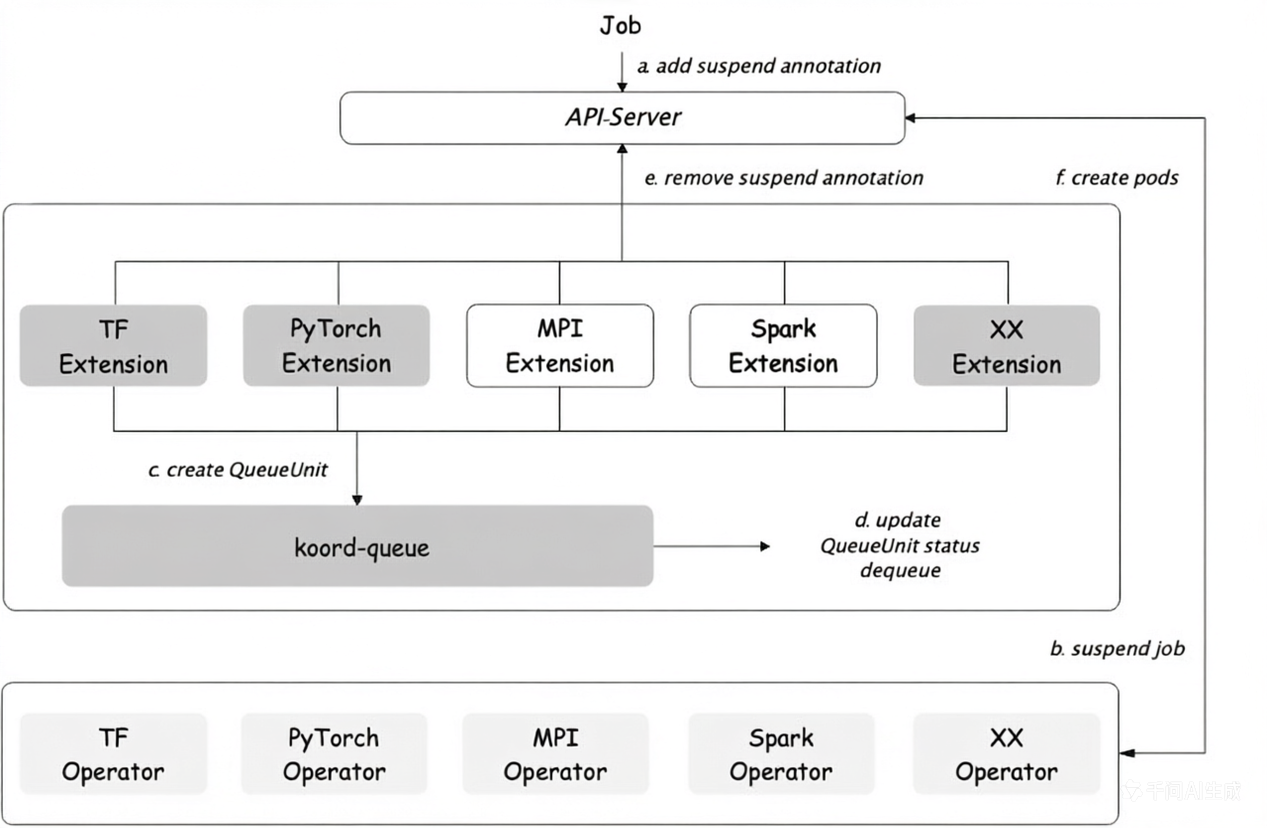
Architecture
The overall system consists of three main parts:
Koord Queue
The Koord Queue is deployed as a Deployment. It listens to the Kubernetes APIServer and manages the lifecycle of QueueUnit resources. Its primary responsibilities include:
- Monitoring
QueueUnitstatus transitions (e.g., fromReservedtoDequeuedwhen all admission checks pass). - Handling admission check results and updating
QueueUnitstatus accordingly. - Managing queue item ordering and position tracking.
The Queue Scheduler watches multiple queues and decides which job (represented by a QueueUnit) should be released. The scheduling process uses a plugin-based framework with the following built-in plugins:
- Priority Plugin: Sorts
QueueUnitswithin a queue by priority (higher first) and creation time (earlier first). - ElasticQuota Plugin: Integrates with Koordinator's individual
ElasticQuotaCRD (scheduling.sigs.k8s.io/v1alpha1) for resource fairness, elastic allocation.
The scheduling cycle for each queue follows:
- Filter - Check if sufficient resources are available via filter plugins.
- Reserve - Reserve resources for the
QueueUnitvia reserve plugins. - Dequeue - Transition the
QueueUnitto the dequeued state and notify the job extension.
Koord Queue Controllers
Koord Queue Controllers monitor real job CRs (such as TFJob, PyTorchJob, MPIJob, Spark, Argo Workflow, and native Kubernetes Jobs) and bridge them with the queuing system. When a new job is created:
- The Koord Queue Controllers creates a corresponding
QueueUnitin the APIServer. - The job is suspended: Kubernetes Jobs use
spec.suspend: true, while other job types (TFJob, PyTorchJob, etc.) use thescheduling.x-k8s.io/suspend: "true"annotation. - When the
QueueUnitis dequeued, the Extension Server removes the suspend flag (setsspec.suspend: falseor removes the annotation), allowing the job to run.
Core Concepts
Queue
A Queue is a namespace-scoped CRD that defines a logical job queue with a specific queuing policy. All Queue resources must be created in the koord-queue namespace, which is the namespace where the Koord-Queue controller is deployed. Each queue can be configured with:
- QueuePolicy: Either
Priority(priority-based ordering) orBlock(strict blocking mode). - Priority: A numeric priority for multi-queue scheduling (higher priority queues are scheduled first).
- AdmissionChecks: A list of admission checks that
QueueUnitsin this queue must pass before being dequeued.
QueueUnit
A QueueUnit is a namespace-scoped CRD that represents a job waiting to be scheduled. Unlike Queue, a QueueUnit can be created in any namespace (typically the same namespace as the job it wraps). It is a wrapper around the actual job (TFJob, PyTorchJob, etc.) and carries the information needed for queuing decisions:
- ConsumerRef: A reference to the original job CR.
- Priority: The priority of this unit within its queue.
- Queue: The name of the queue this unit belongs to.
- Resource/Request: The total resource requirements of the job.
- PodSets: Descriptions of homogeneous pod groups within the job.
QueueUnit Lifecycle
The QueueUnit goes through the following phases:
Enqueued → Reserved → Dequeued → Running → Succeed/Failed
              ↓                ↓
        TimeoutBackoff    SchedReady → SchedSucceed/SchedFailed
     (if admission check       (strict dequeue mode only)
      fails or is rejected)
| Phase | Description |
|---|---|
Enqueued | The QueueUnit has been created and is waiting in the queue. |
Reserved | Resources have been tentatively reserved; admission checks are in progress. |
Dequeued | All admission checks passed; the job is released to run. |
Running | The job's pods are actively running. |
Succeed | The job completed successfully. |
Failed | The job failed. |
SchedReady | (Strict dequeue mode) All admission checks passed, waiting for scheduler confirmation. |
SchedSucceed | (Strict dequeue mode) The scheduler has confirmed the job is schedulable. |
SchedFailed | (Strict dequeue mode) The scheduler determined the job cannot be scheduled. |
TimeoutBackoff | An admission check failed, was rejected, or timed out; the unit will be retried. |
Plugin Framework
Koord-Queue's scheduling decisions are driven by a plugin framework similar in spirit to the Kubernetes Scheduler Framework. Plugins are registered in the plugin registry and executed in defined phases:
| Plugin Phase | Description |
|---|---|
| MultiQueueSort | Determines the order in which queues are processed. |
| QueueSort | Determines the order of QueueUnits within a queue. |
| QueueUnitMapping | Maps a QueueUnit to its target queue/quota group. |
| Filter | Checks whether resources are available for a QueueUnit. |
| Reserve | Reserves resources and records the allocation. |
ElasticQuota Integration
ElasticQuotaV2 Plugin (Individual CR Mode)
The ElasticQuotaV2 plugin integrates with Koordinator's individual ElasticQuota CRD (scheduling.sigs.k8s.io/v1alpha1), where each quota group is a separate resource. This is the default mode (queueGroupPlugin: elasticquotav2).
QueueUnits are associated with ElasticQuota groups via labels (e.g., quota.scheduling.koordinator.sh/name). During scheduling, the plugin checks whether the quota group has sufficient available resources (considering min/max and borrowed resources) before allowing a QueueUnit to be dequeued.
Example of individual ElasticQuota CRs:
apiVersion: scheduling.sigs.k8s.io/v1alpha1
kind: ElasticQuota
metadata:
  name: team-a
  namespace: default
  labels:
    quota.scheduling.koordinator.sh/parent: koordinator-root-quota
spec:
  min:
    cpu: "40"
    memory: 80Gi
  max:
    cpu: "60"
    memory: 120Gi
Key characteristics:
- Each ElasticQuota is a separate CR, typically created in the user's namespace.
- The plugin automatically creates a corresponding
Queueresource in thekoord-queuenamespace for each ElasticQuota. - Parent-child relationships are established via the
quota.scheduling.koordinator.sh/parentlabel. Without this label, the default parent iskoordinator-root-quota. - Supports elastic borrowing: requests within min are always allowed; requests exceeding min but within max can borrow from other groups' idle resources.
For details on ElasticQuota CRD usage, see Capacity Scheduling.
Admission Checks (Work In Progress)
Note: The Admission Check controller is not yet included in this release. This section describes the planned API for future use.
Koord-Queue supports an admission check framework (compatible with Kueue's AdmissionCheck API). Queues can define a list of admission checks that must all pass before a QueueUnit transitions from Reserved to Dequeued. Each admission check has one of the following states:
| State | Description |
|---|---|
Pending | The check is still in progress. |
Ready | The check has passed successfully. |
Retry | The check needs to be retried. |
Rejected | The check has been rejected. |
Supported Job Types
Koord-Queue supports multiple job frameworks through its Extension Server architecture. Each supported type requires enabling the corresponding extension in the Helm values:
| Job Type | Helm Value | Description |
|---|---|---|
| Kubernetes Job | \extension.batchjob.enable\ | Native Kubernetes batch/v1 Job |
| TFJob | \extension.tf.enable\ | TensorFlow training jobs |
| PyTorchJob | \extension.pytorch.enable\ | PyTorch training jobs |
| Argo Workflow | \extension.argo.enable\ | Argo workflow jobs |
| Spark | \extension.spark.enable\ | Spark application jobs |
| Ray | \extension.ray.enable\ | Ray cluster/job |
| MPI | \extension.mpi.enable\ | MPI jobs |
Deployment Architecture
Koord-Queue is deployed via Helm charts and consists of the following components:
| Component | Type | Description |
|---|---|---|
koord-queue | Deployment | The main controller and scheduler. The admissioncheck-controller runs as a sidecar container within this Deployment. |
koord-queue-controllers | Deployment | A separate Deployment handling job framework integrations (TFJob, PyTorchJob, etc.). |
What's Next
- Koord-Queue User Guide: Learn how to install and use Koord-Queue for job queuing.
- Capacity Scheduling: Learn about Koordinator's ElasticQuota management.